Fin de vie de Windows 10 : ce qu’il faut savoir

  • Date officielle de fin de support : Windows 10 (toutes les éditions non-LTSC) arrivera en fin de support le 14 octobre 2025. Après cette date, Microsoft ne fournira plus de mises à jour de sécurité, de mises à jour de fonctionnalités, ni d’assistance technique (support.microsoft.com, microsoft.com).
  • Mises à jour de sécurité étendues (ESU) : Pour ceux qui ont besoin de plus de temps, Microsoft a lancé un programme ESU. Les particuliers peuvent prolonger les mises à jour de sécurité pendant une année supplémentaire, jusqu’au 13 octobre 2026, grâce à plusieurs options :
    • Un plan payant (~30 USD par appareil),
    • L’utilisation de 1 000 points Microsoft Rewards,
    • Ou la synchronisation des paramètres du PC avec OneDrive via un compte Microsoft.

Que faire ensuite ?

  1. Passer à Windows 11
    Solution recommandée si votre matériel est compatible. Vérifiez avec l’outil PC Health Check et via Windows Update.
  2. S’inscrire à l’ESU pour gagner du temps
    Si vous ne pouvez pas encore migrer, vous pouvez prolonger la sécurité jusqu’en 2026 — mais uniquement avec un compte Microsoft.
  3. Sauvegarder vos données
    Utilisez Windows Backup / OneDrive pour protéger vos fichiers et activer certaines options ESU gratuites.

Planifier une migration à long terme
L’ESU n’est qu’une solution temporaire. Il faudra tôt ou tard migrer vers Windows 11 ou une autre solution (ex. MacOS, Linux).

WSUS Content Folder is Full

Problem:

You’ve run out of space on your server and you find out that the WSUS Content Folder is full and it’s eating up space. The WSUS is Windows idea of a centralized update service. In theory, it downloads all the updates for your environment and then distributes them. It does not do a good job of cleaning itself up (consider the manual wizard cleanup) and it comes preconfigured to download the updates for all Windows products, not just the ones you need. As well, when you run the Cleanup Wizard, the console crashes.

Solution:

1. Open up WSUS Console
2. Go to options and only select the updates for the products you need


How to Do a Reset:

Note: You may want to execute the procedure below during off hours as your WSUS server will be downloading quite a bit of data.

1. Close any open WSUS consoles.
2. Go to Administrative Tools – Services and STOP the Update Services service.
3. In Windows Explorer browse to the WSUSContent folder (typically D:\WSUS\WSUSContent or C:\WSUS\WSUSContent)
4. Delete ALL the files and folders in the WSUSContent folder.
5. Go to Administrative Tools – Services and START the Update Services service.
6. Open a command prompt and navigate to the folder: C:\Program Files\Update Services\Tools.
7. Run the command WSUSUtil.exe RESET

This command tells WSUS to check each update in the database, and verify that the content is present in the WSUSContent folder. As it finds that the content is not present in the folder, it executes a BITS job to download the content from Microsoft. This process takes quite a bit of time and runs in the background.

Fin du support Microsoft Windows XP

Depuis le 8 avril 2014, le support et les mises à jour de Windows XP ne sont plus disponibles.

windows-xp-end-of-support


En quoi consiste la fin du support de Windows XP ?

Une version de Windows non prise en charge ne recevra plus de mises à jour logicielles de Windows Update. Celles-ci incluent des mises à jour de sécurité qui permettent de protéger votre ordinateur contre les virus dangereux, les logiciels espions et autres programmes malveillants susceptibles de voler vos informations personnelles. Windows Update installe également les dernières mises à jour logicielles pour améliorer la fiabilité de Windows

Si vous continuez d’utiliser Windows XP après la fin du support, votre ordinateur fonctionnera encore, mais il pourrait devenir plus vulnérable face aux risques de sécurité et aux virus.

Outre les problèmes de sécurité, des problèmes de compatibilité pourront nuire à vos activités puisque de plus en plus de logiciels ou mises à jour de logiciels ne sont pas compatibles avec Microsoft Windows XP.

L’exécution d’un système d’exploitation qui n’est plus pris en charge peut également soulever de sérieux problèmes en termes de réglementations et de conformité pour certains types d’entreprises.

Comment rester protégé ?

Pour rester protégé après la fin du support, deux options s’offrent à vous :

    1. Mettre à jour votre PC actuel

Vous pouvez installer ou mettre à jour votre ordinateur actuel vers Microsoft Windows 7 (toujours disponible pour achat) ou Microsoft Windows 8.1. Nous vous recommandons de télécharger et d’exécuter l’Assistant Mise à niveau de Windows pour vérifier si votre PC possède la configuration minimale pour cette mise à niveau.

    1. Acheter un nouveau PC

Si votre ordinateur actuel ne peut pas exécuter Windows 7 ou Windows 8.1, vous pouvez vous procurer un nouvel ordinateur. En achetant ce nouvel ordinateur, la licence de Windows 7 ou Windows 8 sera incluse pour son installation.

Microsoft Exchange Sever 2013

Microsoft Exchange Server 2013 enables you to maintain control, increase user productivity, and keep your organization safe. You can move to the cloud on your terms with flexible migration options. Your users can do more on any device, helping them manage increasing volumes of email and work together more effectively as teams. You can also protect your business communications and sensitive information, while meeting internal and regulatory compliance requirements. With Exchange Server 2013, you can work smarter, anywhere.

  • Remain in control, online and on-premises.
    Exchange Server 2013 enables you to tailor your solution based on your unique needs and ensures your communications are always available while you remain in control, on your own terms – online, on-premises, or a hybrid of the two.
  • Do more, on any device.
    Exchange Server 2013 helps your users be more productive by helping them manage increasing volumes of communications across multiple devices and work together more effectively as teams.
  • Keep your organization safe.
    Exchange Server 2013 keeps your organization safe by enabling you to protect business communications and sensitive information to meet internal and regulatory compliance requirements.

Microsoft Exchange Server 2013 Preview brings a new rich set of technologies, features, and services to the Exchange Server product line. Its goal is to support people and organizations as their work habits evolve from a communication focus to a collaboration focus. At the same time, Exchange Server 2013 Preview helps lower the total cost of ownership whether you deploy Exchange 2013 Preview on-premises or provision your mailboxes in the cloud. New features and functionality in Exchange 2013 Preview are designed to do the following:

  • Support a multigenerational workforce   Social integration and making it easier to find people is important to users. Smart Searchlearns from users’ communication and collaboration behavior to enhance and prioritize search results in Exchange. Also, with Exchange 2013 Preview, users can merge contacts from multiple sources to provide a single view of a person, by linking contact information pulled from multiple locations.
  • Provide an engaging experience   Microsoft Outlook 2013 Preview and Microsoft Office Outlook Web App have a fresh new look. Outlook Web App emphasizes a streamlined user interface that also supports the use of touch, enhancing the mobile device experience with Exchange.
  • Integrate with SharePoint and Lync   Exchange 2013 Preview offers greater integration with Microsoft SharePoint 2013 Preview and Microsoft Lync 2013 Preview through site mailboxes and In-Place eDiscovery.
  • Help meet evolving compliance needs    Compliance and eDiscovery are challenging for many organizations. Exchange 2013 Preview helps you to find and search data not only in Exchange, but across your organization. With improved search and indexing, you can search across Exchange 2013 Preview, Lync 2013 Preview, SharePoint 2013 Preview, and Windows file servers.
  • Provide a resilient solution   Exchange 2013 Preview builds upon the Exchange Server 2010 architecture and has been redesigned for simplicity of scale, hardware utilization, and failure isolation.

Windows Storage Server

Windows Storage Server is a version of Windows Server that’s licensed to OEMs for use in network-attached storage appliances. Windows Storage Server 2008 included a couple of features — namely single instance storage (file deduplication) and the Microsoft iSCSI Software Target — that differentiated it from other editions of Windows Server 2008. But there are no such distinguishing characteristics of Windows Storage Server 2012, which has no storage features beyond those found in every other edition of Windows Server 2012. Windows Storage Server 2012 is Windows Storage Server only because it is sold exclusively through Microsoft’s hardware partners with storage systems such as the HP StoreEasy 5530.

Windows Storage Server 2012 is available in Workgroup and Standard editions. The Workgroup license is limited to a single CPU socket, 32GB of RAM, six isks, and 250 concurrent SMB connections. The Standard license supports 64 CPU sockets and 2TB of RAM, and it has no restrictions on the number of disk drives or concurrent SMB connections. Standard also has a number of features — notably fail-over clustering, data deduplication, and the ability to host Hyper-V virtual machines — that you don’t get in the Workgroup edition.

Windows 8.1 for Business

Someone’s business device should be just as customized, responsive, and easy to use as their own personal device. Each person in your organization has unique needs. Some need a highly mobile, always connected device. Others need the high performance of a notebook packed with features. Windows 8.1 provides flexibility and choice across a range of options–touch, type, or voice input–individuals can choose the device that best fits their needs.

Workers can customize their Windows 8.1 Preview device to suit their individual needs and work styles. Multiple windows and multimonitor enhancements allow workers to arrange their apps, sites, customize their Start screen, and change their desktop just the way they need to. IT professionals can allow workers to customize their Start screen with relevant apps and live tiles or they can choose to manage the Start screen experience through Group Policy either for individuals or for groups.

With new desktop enhancements, including the new Start button, workers can easily transition between the Start screen and the desktop. IT professionals can also customize the Start button to open the Apps view, which provides a complete list of installed apps. This list can be reordered by category, date, or name, and desktop apps can appear at the front of the list. Windows 8.1 can also boot right to the desktop. In fact, you can start directly in any view– the Start screen, Apps view, the desktop, or even a single app. Make important apps easily accessible in the Start screen on company-issued devices. This includes the ability to manage different Start screen configurations for different groups and roles by using Group Policy.

With assigned access, you can enable a single Windows Store app experience on dedicateduse devices. You might want to run a customer service app in a retail store device, or have a single learning app running in school. Enabling assigned access turns on a predefined set of  filters that blocks other actions so the specified app runs and system files and other apps can’t be accessed. Windows 8.1 makes managing personal devices much easier for Bring Your Own Devices

(BYOD) programs. New features make it possible to more securely allow access to corporate resources–like work folders, apps, and services–from any Internet connection. The management,security, monitoring, and compliance benefits of Windows Server,
Active Directory, Group Policy, Domain Join, System Center, Windows Intune, and MDOP, can continue to support devices running Windows 8.1. You can also benefit from the high levels of hardware and software compatibility with Windows 8.1. The majority of Windows
desktop apps and Windows Store apps will run on Windows 8.1.

Windows 8.1 Preview delivers enterprise-grade security through enhanced access control, improved data protection, and new features that make devices less susceptible to malware threats. Windows 8.1 Preview and Windows Server together introduce many features that make  it easier for you to embrace BYOD programs, keeping your people productive on their own mobile devices, while company information is protected. Windows 8.1 gives you more options to manage user-owned and controlled devices. New Open Mobile Alliance Device Management (OMA-DM) capabilities are built in and enable mobile device management using third-party MDM solutions with no additional agent required. Enhanced policies allow you to manage more settings from both Windows Intune and the third-party MDM solutions for both Windows 8.1 and Windows RT 8.1 devices.

Windows 8.1 personal devices include an option to join the workplace, allowing workers to access network resources, such as a SharePoint site from their personal devices. They can also choose to enroll in the device management service, to gain access to access
to the company portal, get corporate apps, and manage their own device. With work folders, they can access their work files across all their devices, with automatic synchronization to your file servers in your data center and back out to their other devices. IT professionals can enforce dynamic access control policies on the Work Folder Sync Share (including automated rights management.) When workers remove their device from the corporate network, the corporate data can no longer be accessed.

Versions of Windows 8

Windows8

Windows 8
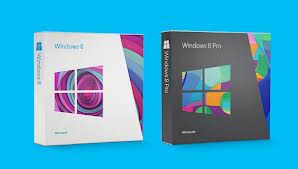
Windows 8 is the basic edition of Windows. This edition contains features aimed at the home users and provides all of the basic new Windows 8 features including the Start screen with semantic zoom, live tiles, Windows Store, Internet Explorer 10, connected standby, Microsoft account integration, the Windows desktop and more.


Windows 8 Pro
Windows 8 Pro is comparable to Windows 7 Professional and Ultimate and is targeted towards enthusiasts and business users; it includes all the features of Windows 8. Additional features include the ability to receive Remote Desktop connections, the ability to participate in a Domain, Encrypting File, Hyper-V, Group Policy, as well as  BitLocker.


Windows 8 Enterprise
Windows 8 Enterprise provides all the features in Windows 8 Pro (except the ability to install the Windows Media Center add-on), with additional features to assist with IT organization. This edition is available to Software Assurance customers, as well as MSDN and Technet Professional subscribers.


Windows RT
Windows RT will only be available pre-installed on ARM-based devices such as tablet PCs. It will include touch-optimized desktop versions of the basic set of Office 2013 applications to users and support device encryption capabilities. Several business-focused features such as Group Policy and domain support are not included.
Desktop software that run on previous versions of Windows cannot be run on Windows RT.

Unlike Windows Vista and Windows 7, there are no Starter, Home Basic, Home Premium, or Ultimate editions.

Microsoft Office 2013

The interface across the entire suite of applications has been reinvented, mostly for the better. First off, the Ribbon, which disappointed many users when it first appeared in Office 2007, remains part of the new Office. But before you start grumbling, consider that Microsoft has made it optional this time around. So now you can show or hide the exhaustive collections of tools across every tab, and decide how much or how little you want to use them.
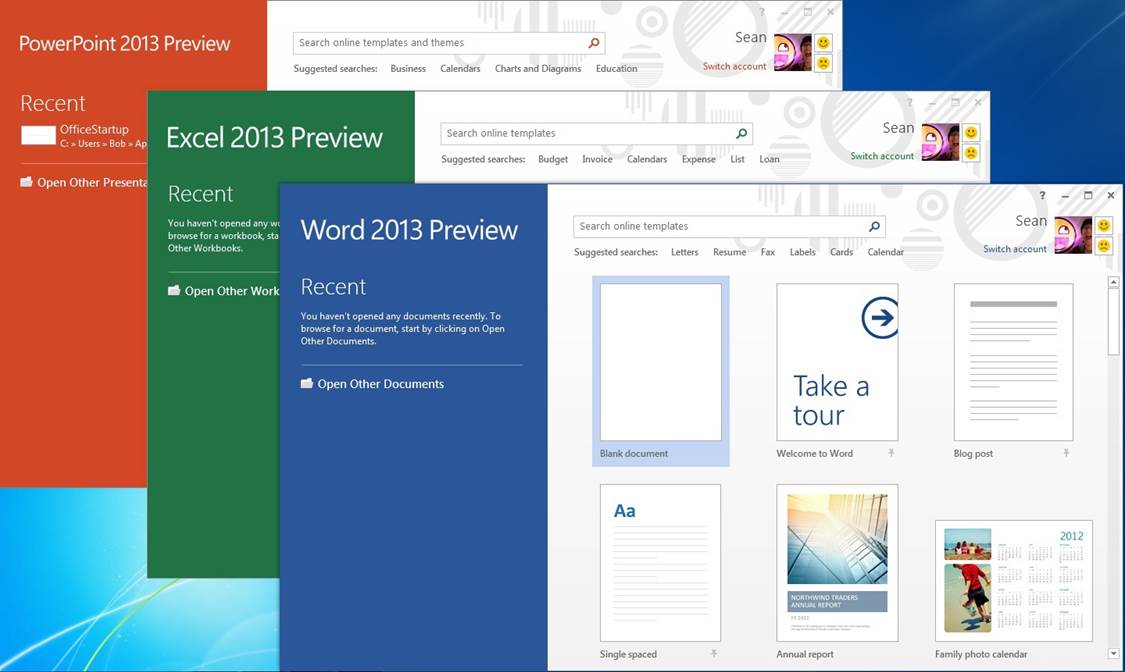
Aside from the Ribbon, the interface is similar but much simpler than it was in Office 2010 and earlier. Newly added start pages for Word, PowerPoint, and Excel help you get to recent documents attached to your account and new templates immediately upon launch. Flat buttons and plenty of white space make the interface look less crowded. Other interface tweaks are tablet-focused such as the radial menus in OneNote that show options (like sharing, search, and zoom tools) in a circle around the area you press. The general feel of the suite is more streamlined and more cloud-integrated, and the new start pages for the core apps will be especially useful for those looking at the same documents on several devices.

Office2013

Though you can only use Office 365 with a subscription on five machines, another new feature called Office on Demand will come in handy whenever you’re away from your selected devices. This feature lets you download a full copy of the software you need (such as Word or Excel) on any PC running Windows 7 or later, and shows you your recent documents just as you’d see them at home. When you’re finished making changes or edits to a document, you can close the application and it is removed from the PC you’re working on.

32-bit vs. 64-bit

The terms 32-bit and 64-bit refer to the way a computer’s processor (also called a CPU), handles information. The 64-bit version of Windows handles large amounts of random access memory (RAM)  more effectively than a 32-bit system.64-bit processors can represent larger chunks of data at a time than 32-bit  processors, allowing more efficient handling of all types of computer  calculations. Although 64-bit processing is inherently faster, it also requires  more RAM to accommodate the larger  chunks of data and provide better system performance.

32-bit operating systems can only use about 3.5 gigabytes (GB) of RAM, even if  you install more; 64-bit operating systems can use much more. For example, the  64-bit versions of Windows 7 Professional and Ultimate support up to 192 GB of  RAM. You need at least 4 GB of RAM in order to  experience an increase in system performance with 64-bit processing. If you have  less than 4 GB of RAM, moving to 64-bit could actually decrease system  performance.

Generally, 32-bit software is compatible with 64-bit versions of Windows, but  64-bit software is not compatible with 32-bit versions of Windows. Microsoft  notes that one exception to this is that many 32-bit anti-virus programs do not  work in 64-bit versions of Windows.

Also, it is not possible to upgrade directly from a 32-bit to 64-bit version of Windows or vice versa. If you want to make the change, you  will need to perform a clean install, which means that you will need to back up  your files and reinstall all your software.

32-Bit vs. 64-bit

The terms 32-bit and 64-bit refer to the way a computer’s processor (also called a CPU), handles information. The 64-bit version of Windows handles large amounts of random access memory (RAM) more effectively than a 32-bit system. Because a 64-bit operating system can handle a large amount of memory (4GB or more), it can be more  efficient than a 32-bit operating system; a 64-bit system can be more responsive when running several programs at the same time and switching between them frequently.

Most programs designed for a computer running a 32-bit version of Windows will work on a computer running 64-bit versions of Windows. Notable exceptions are many antivirus programs, and some hardware drivers. (Microsoft Website).
You cannot upgrade from a 32-bit system to a 64-bit system without going through the process of reeinstalling Windows operating system.